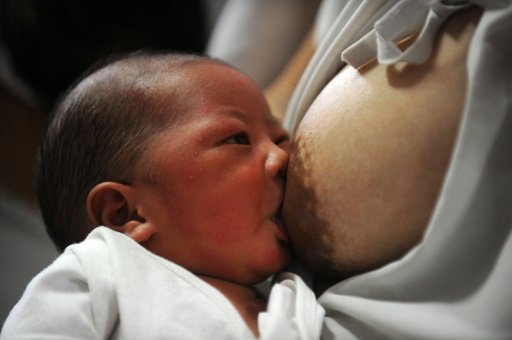
A new international study, which aggregates data from 164
countries, concluded that the spread of breastfeeding is good for babies, for
moms, but also for the economy. Explanations.
Exclusive breastfeeding until age six months is a public
health issue. But not only. Prolonged breastfeeding could save the lives of
more than 800,000 babies each year while saving billions of dollars to health
systems globally through its role in protecting against certain childhood
diseases, according to a series of studies published this Friday.
"Only one in five children are breastfed up to twelve
months in rich countries while only one in three children is exclusively
breastfed in the first six months of its existence in countries with low and
middle income," says the British medical journal The Lancet.
They are thus millions of children who do not benefit fully
from the benefits of breast milk, the researchers note.
More than 800,000 lives saved
Breast milk covers all the nutritional needs of the baby
during the first six months of life. The World Health Organization (WHO)
recommends breastfeeding as "exclusive" to the age of six months and
partial breastfeeding up to two years. According to her, less than 40% of infants
worldwide benefit today.
Besides purely based food, breastfeeding is known for a long
time to have beneficial effects both on the health of the infant and the
mother.
Breastfeeding long term "could save more than 800,000
children's lives each year worldwide, equivalent to 13% of all deaths in
children under two years," say the authors based on a series of studies.
It could also prevent the deaths each year of 20,000 consecutive mothers to
breast cancer, they add.
Reduced risk of cancer
And, unlike a "false idea and widespread", the
benefits of breastfeeding are not confined to poor countries. "Our
research clearly shows that breastfeeding saves lives and helps to save money
in all countries, both rich and poor," they write. Hence the need,
according to them, to address the problem globally.
"In rich countries, breastfeeding reduced by more than
a third of sudden infant death. In poor or middle-income countries, about half
of diarrhea epidemics and third respiratory infections could be prevented
thanks to breastfeeding ", say the researchers.
The long-term breastfeeding also help reduce the risk of
obesity and diabetes in children. For mothers, it would reduce the risk of breast
cancer and ovarian cancer.
Considerable cost savings for the health
The researchers also calculated that bringing to 90% the
rate of exclusive breastfeeding up to six months in the United States, China
and Brazil and 45% in the UK, this would reduce the costs of treatment of
common childhood diseases such as pneumonia, diarrhea or asthma.
With breastfeeding "savings for the health care system
at least $ 2.45 billion in the US, 29.5 million in the UK, from 223.6 million
in China and 6 million Brazil "would be feasible. In rich countries, the
United Kingdom, Ireland and Denmark breastfeeding rates to twelve months the
lowest in the world (respectively less than 1%, 2%, 3%).
A loss of $ 302 billion
Based on a previous study, published in March 2015, which
held that breastfeeding contributes to increased intelligence, longer schooling
and thus better income as adults, they feel that the weakness of breastfeeding
was a loss of $ 302 billion (0.49% of global GDP) in 2012.
The scientists also complain of aggressive advertising in
favor of infant formula that undermine, according to them, the authorities'
efforts to promote breastfeeding. "The saturation of rich country markets
has led manufacturers to rapidly enter emerging markets", they add.
"Global milk sales (substitution) increased in value
from two billion in 1987 to 40000000000 approximately in 2014," they note.
According to them, the countries are yet able to
significantly improve the practice of breastfeeding. For example, in Brazil,
the duration of breastfeeding increased from 2.5 months in the years 1974 to
1975 to 14 months in 2006-2007 through proactive policy of health services and
broad information campaigns .


No comments:
Post a Comment